

APRIL 2026

Past Editions—Need to Know Archives
IN THIS EDITION:
Here’s what retailers need to know:
- Connect with CRN at NACDS to talk supplements
- CRN petitions Supreme Court to review New York age restriction case, with potential national impact
- CRN tracking California proposals on protein, sports-nutrition, and ‘sell-by’ labeling
- Reality check: Unresolved rulemaking on DSHEA disclaimers leaves stakeholders vulnerable to plaintiffs’ lawyers
Heading to the NACDS Annual at The Breakers? Let’s talk supplements.
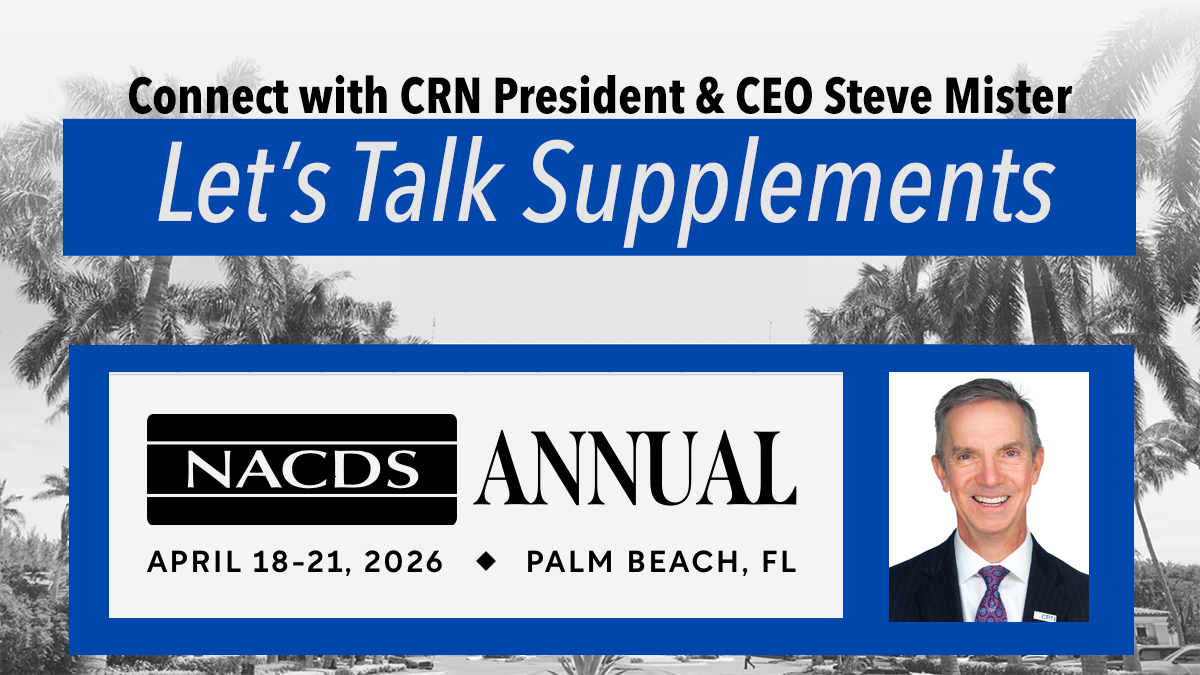
CRN President & CEO Steve Mister is attending the NACDS Annual at The Breakers, April 18–21, and would welcome the opportunity to connect on the latest developments affecting the supplement aisle.
Top of mind issues for retail right now:
- New age-verification and product-access rules for certain supplements continue to be proposed in the state legislatures;
- Protein products in the crosshairs, with California legislation that would create new testing and disclosure requirements related to heavy metal content;
- Sell-by date scrutiny, with continued uncertainty around efforts in California and New York to regulate expiration labeling and food-date terminology; and
- FDA’s recent announcement on enforcement discretion for the DSHEA disclaimer: what it does—and does not—mean for retailers facing litigation risk.
CRN is actively engaged on all of these issues and can help retailers understand what may affect merchandising, e-commerce, store operations, and supplier expectations in the months ahead.
Get in touch: Contact Steve via email—smister@crnusa.org—or message on LinkedIn to set up a time for a brief meetup at The Annual.
CRN’s Supreme Court petition matters to retailers far beyond New York

CRN has petitioned the U.S. Supreme Court to review New York’s law restricting the sale of certain dietary supplements to consumers under 18 when those products are “labeled, marketed, or otherwise represented” for weight loss or muscle building.
For retailers, that distinction matters: the trigger is not simply ingredient-based. It is tied to claims, presentation, and promotion—raising the stakes, as well as potential confusion, for shelf tags, digital product pages, merchandising language, and other consumer-facing communications.
CRN’s petition argues that truthful, non-misleading speech should not be the basis for sweeping sales restrictions on lawful products and asks the Court to address whether states can justify those restrictions without real evidence that they materially advance public-health goals.
The case is worth watching closely because New York is no longer an isolated example. Similar age-restriction proposals continue to surface in multiple states, which means compliance decisions made in one jurisdiction can quickly become relevant elsewhere.
CRN's litigation impacts the marketplace beyond the state of New York. It is part of a broader battle for commercial free speech with the potential to impact whether merchandising and marketing language can trigger sales bans, ID-check obligations, or locked-case requirements for otherwise lawful supplement products. CRN will continue to keep retail partners informed as the case develops.
CRN tracking California proposals affecting protein, sports-nutrition, and ‘sell-by’ labeling

California continues to be one of the most important states for retailers to watch with legislative activity that can set the stage for other states to follow suit—or stand down, if education or opposition shifts sentiment.
Regarding food date-labeling, CRN is still seeking clarification that dietary supplements are excluded from California’s new law, AB 660, which, as reported in our last edition, takes effect July 1, 2026, and standardizes shelf-life date labeling for “food items for human consumption,” requiring the use of specified terms such as “BEST if Used by” and “USE by” while prohibiting other date-labeling terminology.
Recently introduced legislation would impose new testing, disclosure, and labeling requirements for protein powder and other concentrated protein products sold in California. Advancing out of the Senate Health Committee on March 25, as amended, SB 1033 would require lot-by-lot heavy metals testing and new disclosures for packaged protein products, including information on-pack and on online product detail pages beginning in 2028.
- CRN opposes the bill and has warned that a state-specific regime could increase costs, create consumer confusion, and disrupt the federal uniformity retailers depend on across stores and e-commerce channels.
Separately, California’s age-restriction bill, AB 2030, would restrict the sale of certain weight-loss and muscle-building supplements to minors and would go even further than some past proposals by adding physical retail access restrictions and stronger penalties.
Especially relevant for retailers, these bills affect not only checkout procedures, they can affect placement, self-service access, online sales workflows, and front-line compliance.
California is not alone. For retailers, the message is clear: state-by-state supplement policy threatens to present real operational issues, not just manufacturer issues. CRN is a resource for retailers assessing where proposals could affect assortment, access, and consumer communications.
Reality check: Unresolved rulemaking on DSHEA disclaimers leaves stakeholders vulnerable to plaintiffs' lawyers

CRN welcomed FDA’s enforcement discretion in December on the requirement that the DSHEA disclaimer appear on each panel of a product label where a structure/function claim appears.
Yes, but: FDA's announcement and letter signaling its interest in amending the rule notwithstanding, the current actions do not appear to go far enough to stem class action litigation targeting DSHEA disclaimer placement.
- For example, in a recent opinion in a class action case involving Amazon, the judge denied Amazon’s motion to stay the case despite FDA's announcement.
What they're saying: In determining that a stay was not appropriate pending any additional FDA action, the court focused on the fact that FDA had not definitively announced it would amend the regulation, as well as that any amendment likely would not have a retroactive effect.
CRN is escalating the issue with FDA in light of recent litigation concerns and the potential for a protracted amendment process.
How we got here: In December, FDA announced that it intends to exercise enforcement discretion on the requirement that the DSHEA disclaimer appear on each panel of a product label where a structure/function claim appears, and said it is considering amending the regulation to remove that “each panel” requirement altogether. FDA said that approach would better reflect the statute while reducing label clutter and unnecessary cost.
While a meaningful development for retailers, it has not fully eliminated litigation risk, with at least one court's denial to pause a class action involving disclaimer placement despite FDA’s announcement, underscoring that plaintiffs’ lawyers may continue testing these cases while formal rulemaking remains unresolved.
Retailers should continue to review claim-disclaimer presentation carefully and work with responsible supplier partners.
CRN will keep pushing for clarity that better reflects longstanding practice and reduces unnecessary litigation exposure.