

FEBRUARY 2026
Questions about these supplement industry updates? Connect with Ed Wyszumiala (ewyszumiala@crnusa.org) 989-598-5275 or via LinkedIn for a complimentary consultation. Learn more about CRN membership here.
CRN warns latest age-restriction bill would mislead policymakers and burden retailers
CRN reiterated its opposition to Hawaii Senate Bill 2106 (SB 2106), legislation that would prohibit the sale of certain weight management and muscle-building dietary supplements to individuals under the age of 18 and further demand that retailers restrict all consumers’ access to these products by removing them from any self-service display.
CRN has held off age restriction proposals in several states and is currently engaged in litigation with the state of New York to repeal its age restriction law that went into effect in April 2024.
There is no credible scientific evidence demonstrating a causal relationship between the use of dietary supplements and the development of eating disorders among minors. Eating disorders are complex mental health conditions with a wide range of contributing factors, and policies that single out FDA-regulated dietary supplements will not address the root causes of these conditions or improve outcomes for young people. These restrictions only scapegoat safe and legal products and serve up false hope that restricting them will solve the eating disorder epidemic.
CRN’s opposition was formally conveyed during a virtual legislative hearing on February 2, where Andrea Wong, Ph.D., SVP & Chief Science Officer at CRN, testified in opposition to SB 2106. In her remarks, Dr. Wong emphasized that the bill is not rooted in sound science and risks misleading policymakers and the public.
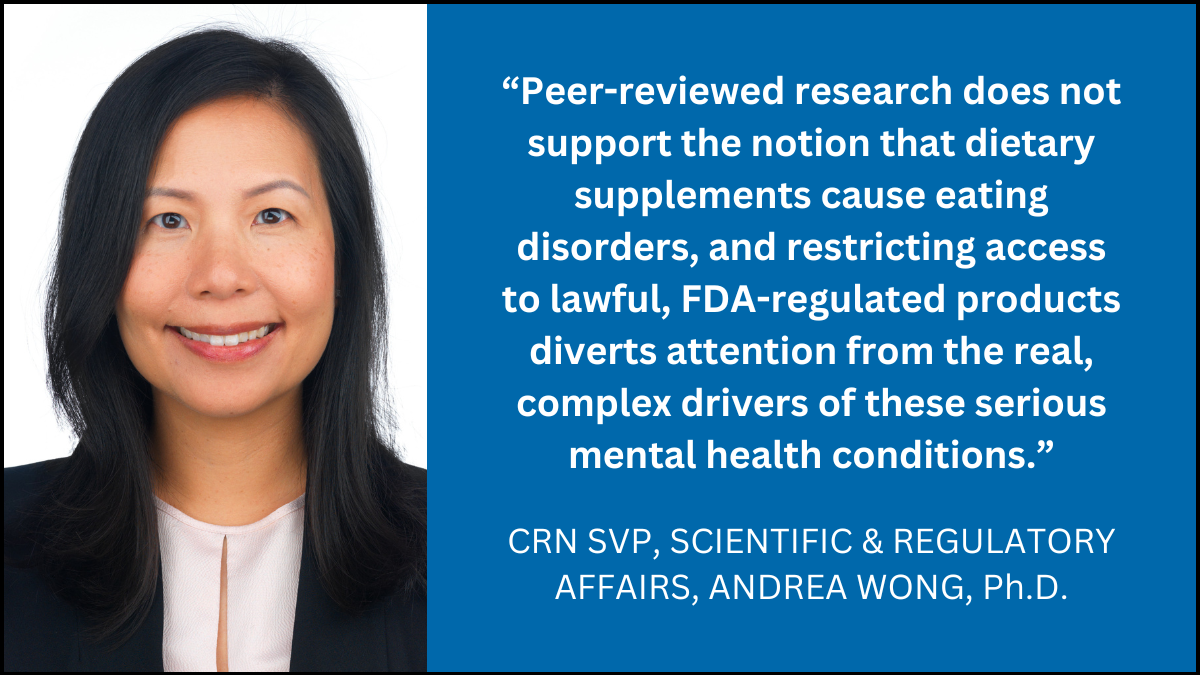
“SB 2106 is not based on a scientific assessment of risk,” said Wong. “Peer-reviewed research does not support the notion that dietary supplements cause eating disorders, and restricting access to lawful, FDA-regulated products diverts attention from the real, complex drivers of these serious mental health conditions.”
Peer-reviewed research has found no known causal link between dietary supplement use and the onset of eating disorders, and additional studies have concluded that common weight-management ingredients—many of which could be impacted by this bill—are safe when used as directed. Despite this evidence, SB 2106 would restrict access to lawful products that are regulated at the federal level and safely used by millions of Americans.
The dietary supplement industry plays an important role in Hawaii’s economy, generating more than $220 million in economic impact, supporting nearly 1,000 jobs, and contributing nearly $42 million in tax revenue. Legislation that restricts lawful products without scientific justification threatens consumer choice, economic vitality, and trust in public health policymaking.
CRN applauds FDA clarification on DSHEA disclaimer after years of advocacy
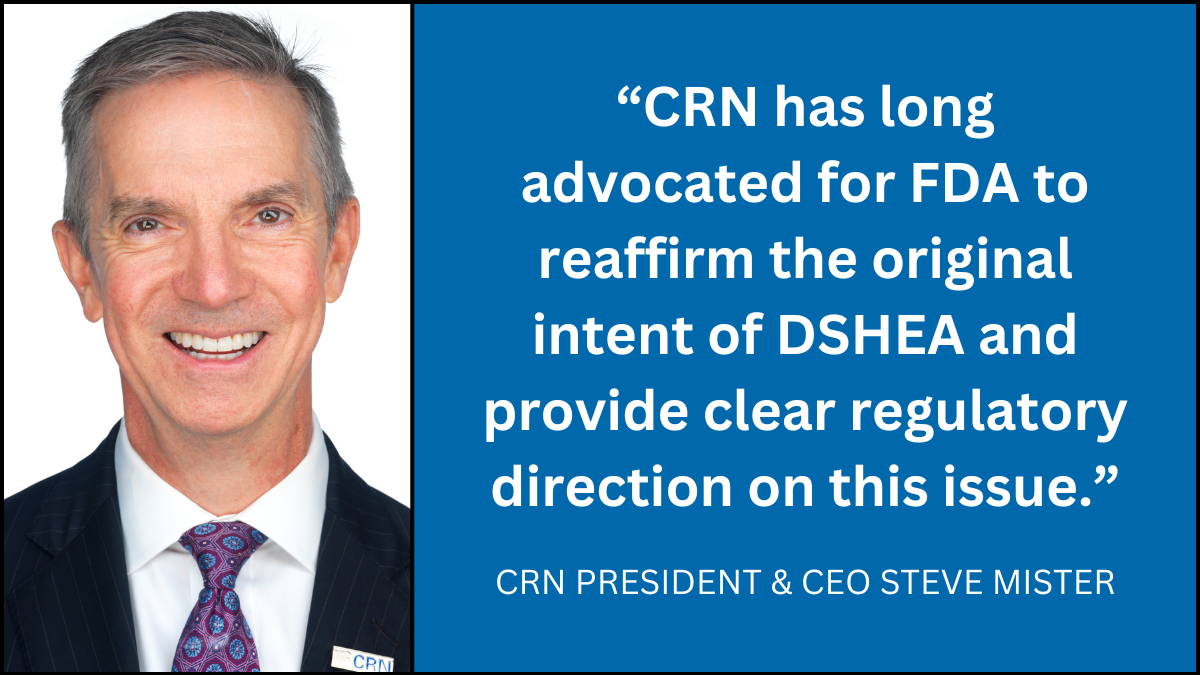
CRN commended FDA for providing needed clarity on the placement of the Dietary Supplement Health and Education Act (DSHEA) disclaimer on product labels.
For nearly 30 years, FDA practice has allowed the use of an asterisk to direct consumers to the full DSHEA disclaimer elsewhere on the label, consistent with section 403(r)(6)(C) of the Food, Drug & Cosmetic Act and 21 C.F.R. § 101.93(d). However, a recent uptick in class-action lawsuits has relied on an alternative interpretation, arguing that the full disclaimer must be placed on every panel where a structure/function claim is used on a product label. These legal challenges have created confusion, prompted unnecessary litigation, and imposed costly and disproportionate burdens on responsible manufacturers—without improving consumer understanding.
Earlier this year, CRN called on FDA [starting on page 23] to revise section 101.93(d) to clarify that the law does not require duplicative use of the DSHEA disclaimer on multiple panels of the same product. CRN offered then that making the change “would maintain adequate levels of consumer protection while reducing unnecessary, redundant regulatory burdens on companies,” and argued that a single disclaimer on a dietary supplement product’s label linked by an asterisk or other symbol to structure/function claims adequately informs consumers of the existence of additional information and satisfies the legislative intent to have a structure/function statement “contain” the disclaimer. Separately, CRN made clear to the agency that it was prepared to file a citizen petition to formally escalate the matter if needed.
CRN joins Recycling Leadership Council to advance clarity in recycling policy
CRN recently participated in the first kickoff call of the Recycling Leadership Council (RLC), a new cross-industry coalition focused on reducing plastic waste by establishing clear, consistent national recycling definitions.
- CRN is the only dietary supplement trade association participating in the RLC, ensuring the supplement industry’s perspective is represented as policy solutions are developed.
The RLC officially launched on Jan. 15 with a new website, social media channels, and targeted media outreach, followed by expanded advocacy and communications tied to the introduction of the Recycled Materials Attribution Act (RMAA). The coalition is pursuing a bipartisan, narrowly tailored legislative approach aligned with the FTC Green Guides, focused on material-to-material recycling and improving clarity for consumers, regulators, and manufacturers.
Why it matters: Clear, consistent recycling definitions are critical to improving consumer confidence, supporting responsible companies, and encouraging investment in U.S. recycling infrastructure. CRN’s participation ensures dietary supplement companies have a voice in shaping pragmatic, workable recycling policy.
ACCESS PAST WEBINARS ON DEMAND
Why a federal supplement registry supports MAHA, consumers, and responsible industry
As debate continues around federal oversight of dietary supplements, CRN President & CEO Steve Mister outlined the case for a mandatory product registry as a tool to strengthen transparency, consumer confidence, and responsible industry oversight in a recent NutraIngredients-USA byline.
Mister argues that the MAHA movement is rooted in giving consumers clear, reliable information about what they put into their bodies, and that a mandatory product listing supports that goal by making the supplement marketplace visible—without introducing premarket approval or altering DSHEA’s post-market framework.
Why it matters: Mister contends that when FDA lacks a comprehensive view of products on the market, uncertainty grows during safety events, such as recalls. Without a basic inventory, regulators cannot quickly identify affected products, retailers may overreact, and responsible companies can be swept up alongside bad actors. He characterizes this not as a failure of enforcement, but as a failure of visibility.
Effective oversight starts with visibility. Mister noted that a registry would create a simple, enforceable requirement: products already on the market must be listed, and failure to list would equal misbranding. Properly designed, he writes, it would function as basic regulatory infrastructure, enabling faster, more precise responses while preserving innovation and consumer access.
Go deeper: Read Mister’s full byline on why a dietary supplement registry is pro-MAHA, pro-consumer, and pro-industry.
CRN challenges Freakonomics’ one-size-fits-all portrayal of dietary supplements
CRN issued a statement in response to a Jan. 9 Freakonomics Radio episode, “This Is Your Brain on Supplements,” part of The Freakonomics Radio Guide to Getting Better.
CRN’s member companies are committed to integrity in labeling and advertising, compliance with FDA and FTC requirements, and clear communication regarding both the appropriate use of supplements and their limitations. These companies have long supported strong regulatory oversight, transparency, and continued scientific research into dietary supplements, including those marketed for cognitive and brain health.
CRN welcomes rigorous discussion and continued examination of this category, including conversations prompted by episodes such as Freakonomics Radio’s “This Is Your Brain on Supplements.” We believe the most constructive dialogue is nuanced, evidence-based, and acknowledges both the limitations of supplements and the legitimate role that responsibly manufactured products can play in supporting overall health.

NBC News examines vitamin B6 safety — includes CRN perspective
The news: NBC News published a Jan. 29 story examining vitamin B6 safety amid increased attention on rare toxicity cases tied to high supplemental intakes, particularly from energy drinks, electrolyte mixes and fortified products.
What they’re saying:
- Vitamin B6 toxicity is described as uncommon but increasingly reported, as B6 appears in more everyday products.
- Symptoms can develop gradually, including peripheral neuropathy and sensory changes.
- Most consumers meet their vitamin B6 needs through diet alone.
CRN’s role:
- Andrea Wong, Ph.D., CRN senior vice president and chief science officer, is quoted emphasizing that safe intake depends on individual factors and total exposure from all sources.
- Wong reiterated that CRN’s supplemental upper level of 100 mg/day is considered safe for the general healthy population.
- Her comments align with CRN’s broader science-based work on nutrient safety, including its recently updated Vitamin B6 chapter in Vitamin and Mineral Safety: 4th Edition.
Why it matters:
- CRN’s inclusion helps ensure a balanced, evidence-based narrative in coverage that could otherwise skew alarmist.
- The story underscores the importance of consumer education on cumulative intake and label literacy, not just single products.
- As international regulators revisit B6 limits, credible expert voices will continue to shape public understanding and policy debates.
Bottom line: NBC’s reporting raises awareness of B6 safety while incorporating CRN’s science-driven perspective, reinforcing the industry’s role in responsible nutrition dialogue.