

Q&A with Trygve Bergeland, PhD, Nutrition Science Director, Balchem, discussing his white paper “The Role of Vitamin K2 in Bone Development for Growing Children”
Q: What are the key stages of bone development during childhood and adolescence, and why are these years critical for lifelong skeletal health?
Trygve: The first sign of bone is seen early in life (around the 7th week of gestation). Bones grow in length, thickness and a lot of different shapes. Longitudinal growth is done by the growth plates and much of the thickness is done by bone modeling. The shaping of bones is regulated in different ways, like secondary growth plates and bone modeling.
From birth to adulthood the bone mineral content is increased by a factor of 40, and 40-60% of this increase happens in short windows during adolescent years when the growth spurts occur. When the growth plates calcify and close the peak bone mass is reached. This happens around the age of around 20 years. A high peak bone mass maintains a healthy skeleton during adulthood and ageing years.
Q: How do bone modeling and bone remodeling differ, and what roles do they play during periods of growth?
Trygve: Two important cell types are involved in both bone modeling and remodeling. In short, osteoblasts are bone builders, and osteoclasts are bone degraders. In bone modeling, osteoblasts and osteoclasts are acting on different locations, allowing increased bone mass and shapes. This process occurs mostly in childhood and adolescence. In bone remodeling, osteoblasts and osteoclasts are acting on the same location in a sequence. This is initiated by microfractures where bones must be repaired. Osteoclasts remove the damaged bone before osteoblasts arrive and build new bone tissue. Bone remodeling is a lifelong process starting early in life.
Q: What biological processes regulate the balance between bone formation and bone resorption in growing children?
Trygve: Osteoblasts and osteoclasts originate from different stem cells in bone, and the maturation towards active cells is a continuous process regulated by growth factors and small chemical mediators. Lifestyle, body weight, activity level, food and micronutrients have impacts on the growth factors and small chemical mediators and by that they will influence the balance between bone formation (by osteoblasts) and bone resorption (by osteoclasts).
Q: How do micronutrients influence bone mineralization and overall bone quality during growth?
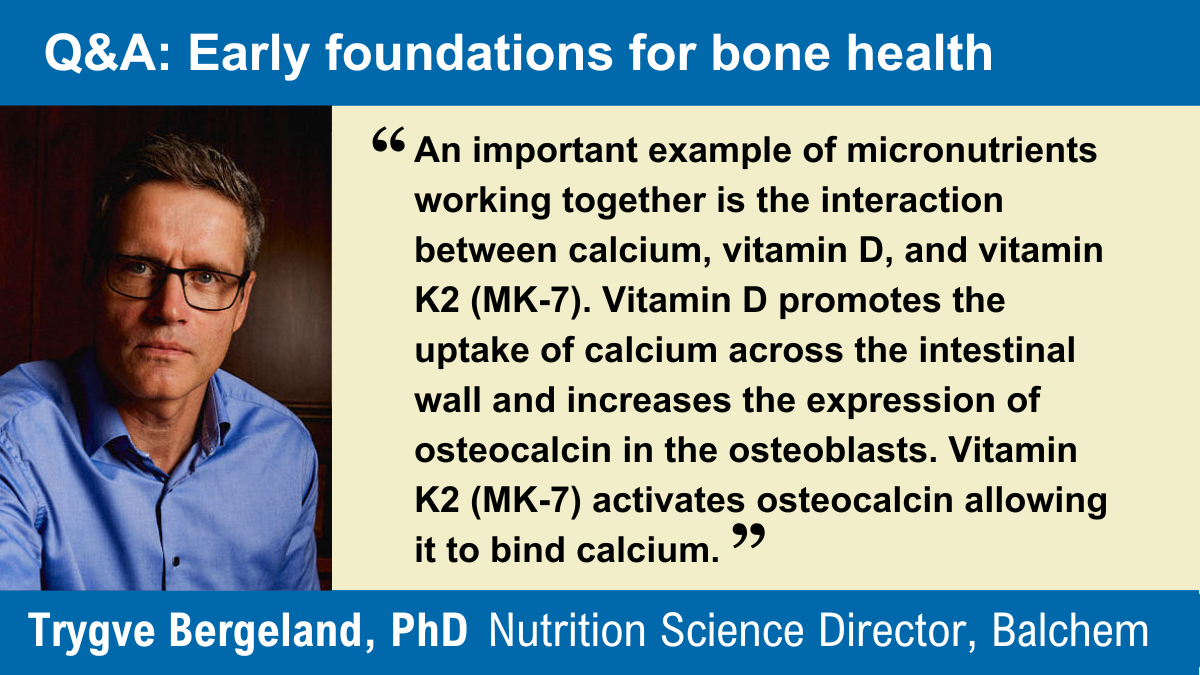
Trygve: The skeleton is defined by some non-modifiable factors, like genes and gender, and some modifiable factors, like weight, activity level, food and intake of micronutrients. An important example of micronutrients working together is the interaction between calcium, vitamin D, and vitamin K2 (MK-7). Vitamin D promotes the uptake of calcium across the intestinal wall and increases the expression of osteocalcin in the osteoblasts. Vitamin K2 (MK-7) activates osteocalcin allowing it to bind calcium. In vitro studies have shown that vitamin K2 can downregulate the action of osteoclasts and promote the action osteoblasts.
Q: Osteocalcin is often used as a marker of bone activity. What does its activation status reveal about bone health in children?
Trygve: Osteocalcin is the second most abundant protein in bone (next to collagen). It is exclusively expressed by osteoblasts and secreted as part of the osteoid that gradually over time will be mineralized. Osteocalcin can be in an inactive (uncarboxylated) state and an active (carboxylated) state. The activation is facilitated by an enzymatic reaction dependent on vitamin K and allows Ca2+ to bind osteocalcin within the osteoid. The ratio between the inactive and active osteocalcin is often used as a biomarker for bone activity. Interestingly, correlation studies have shown that children have a very high level of inactive osteocalcin when compared to adults. One longitudinal study on growing children has shown that improvements in the carboxyation status of osteocalcin over a period of two years was associated with a marked increase in bone mineral content.
Q: Research has identified high levels of inactive osteocalcin in children and adolescents. What does this suggest about nutrient status during growth?
Trygve: Studies have reported that children exhibit up to six times higher levels of inactive osteocalcin compared to adults, indicating an increased requirement for vitamin K during childhood. The high levels of inactive osteocalcin suggests that the vitamin K requirement of bone during growth is often not met by the dietary vitamin K supply.
Q: Studies have linked nutrient status to differences in bone mineral content and stature. How should these associations be interpreted?
Trygve: Lately two correlation trials have shown that the prevalence of low vitamin K2 in blood was higher in children with short stature compared to children with normal stature. However, the causality must be investigated by prospective clinical trials where vitamin K2 is supplemented.
Q: How does peak bone mass achieved in adolescence influence fracture risk and skeletal health later in life?
Trygve: The peak bone mass is achieved when the growth plates calcify and close by the age of around 20 years. After this period, the bone mass is plateaued and will start to decline after 50 years of age. In the beginning the decline is slow and it accelerates by age. A low bone mass increases the risk of fractures, osteopenia and osteoporosis. A high peak bone mass sets the tone of the skeleton and might prolong the years of a healthy skeleton as you age.
Q: What limitations exist in the current evidence base on nutrition and pediatric bone health?
Trygve: Few double-blind, placebo-controlled clinical trials exist, and most current evidence comes from correlation studies. More randomized, controlled trials are required.
Q: What key research questions remain regarding optimal nutritional support for bone development in children?
Trygve: Double-blind, randomized clinical trials with clinically relevant endpoints are still needed to fully assess the effects of micronutrients on bone health. For vitamin K2 (MK-7) key endpoints should include bone mineral content and density, fracture rates, and height. Since micronutrients, like MK-7, act gradually over time, any benefits will require extended periods to become measurable. Therefore, long-term interventions and large sample sizes will be necessary to obtain meaningful results.