

MAY 14, 2026 — SPECIAL UNLOCKED EDITION

- Register now for CRN's 2026 Day on the Hill; hotel room block closes tomorrow
- California SB 1033 stalls for 2026 legislative session
- Sergeant Searchlight returns to tackle online marketplace transparency
- FDA finalizes food chemical reassessment framework, launches BHT and ADA reviews
- Learn about food supplements regulation in Europe from experienced regulatory experts
- CRN pushes back on 'Last Week Tonight' host John Oliver’s DSHEA claims
- FDA highlights nutrition during National Women’s Health Week
- Supplement Source spotlight: Nutrition access initiative gains momentum
- Best pricing ends tomorrow for Legal, Regulatory and Compliance Forum
- California advances SB 54 rollout with finalized regulations and producer guidance; EPR deadlines approach in several states
- Celebrate trailblazing leaders in the CRN members community—nominations due May 30
- CRN member companies honored for ingredient innovation and research excellence
- Media Mentions
Register now for CRN's 2026 Day on the Hill; hotel room block closes tomorrow
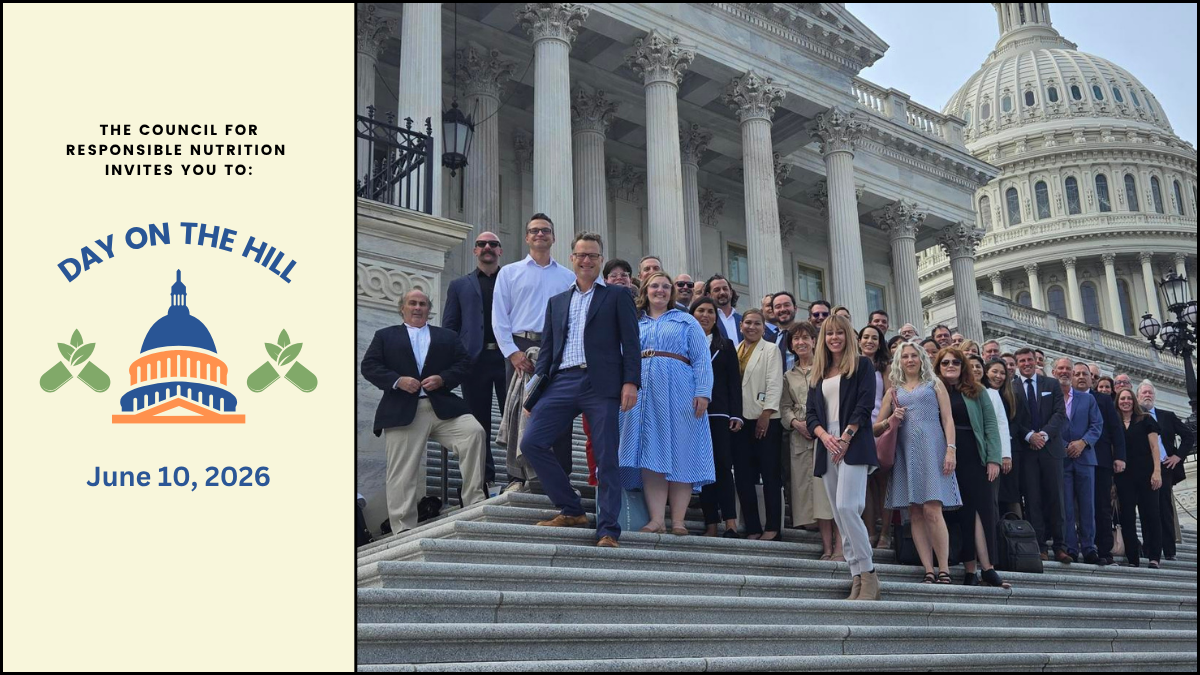
Be part of the conversations shaping the future of the supplement industry during CRN’s 2026 Day on the Hill.
CRN members, get details here.
Go all in: Don’t miss this impactful opportunity to advocate alongside fellow CRN members and industry leaders on Capitol Hill.
California SB 1033 stalls for 2026 legislative session
California Senate Bill 1033 is not expected to advance through the legislature this session following significant engagement and advocacy efforts by CRN’s government relations team and the association’s Sacramento-based lobbyists.
The background: The bill would have required lot-by-lot heavy metal testing and public disclosure for bulk protein products and packaged protein products sold in the state, along with new labeling and website mandates starting in 2028.
How we got here: CRN most recently engaged in discussion with bill author California State Sen. Padilla and NGO sponsors, plus Consumer Brands Association (CBA) the first week of May, following regular engagement with Sen. Padilla and his staff, as well as the CBA and other California agriculture/food groups since the bill's introduction in February. The CRN team's practice of engaging in actual dialogue with the opposition and legislator and convening stakeholders to talk through issues with introduced bills was critical to our mitigating the threat of these misguided efforts and educating on scientific and regulatory realities.
CRN will share additional details with members as more information becomes available.
Sergeant Searchlight returns to tackle online marketplace transparency

CRN’s “Sergeant Searchlight” campaign is continuing to build support for dietary supplement listing legislation, highlighting how greater marketplace transparency could strengthen consumer confidence, support responsible companies, and give FDA better visibility into products being sold.
What’s happening: In “Episode Two: The Web of Shadows,” Sergeant Searchlight turns his attention to the digital marketplace, illustrating how FDA may not always know which supplement products are being sold online or who is marketing them. The latest installment reinforces CRN’s position that supplement listing would help bring more transparency and accountability to the marketplace.
The message: A registry of supplement labels would provide regulators, retailers, and consumers with greater visibility into products on the market, while helping responsible companies stand apart from actors operating outside industry best practices.
The big picture: While Sergeant Searchlight may be the face of the campaign, the real heroes are the responsible supplement companies already committed to transparency by manufacturing quality products and voluntarily uploading labels to the Supplement OWL registry.
Between the lines: The comic-style campaign continues to use storytelling and educational visuals to simplify a complex policy issue while reinforcing CRN’s long-standing message that “you can’t regulate what you can’t see.” CRN maintains that a supplement listing would not create a pre-approval system for supplements, but instead improve visibility across the marketplace.
What to watch: Additional Sergeant Searchlight installments are expected to roll out in the coming weeks as the campaign continues encouraging support for dietary supplement listing legislation.
Go deeper: Explore the latest Sergeant Searchlight episode and learn more about CRN’s push for dietary supplement listing here.
FDA finalizes food chemical reassessment framework, launches BHT and ADA reviews
FDA this week finalized its new post-market assessment framework for chemicals in food and launched reassessments of butylated hydroxytoluene (BHT) and azodicarbonamide (ADA), two food additives used in a variety of products.
Why it matters: The finalized framework outlines how FDA will identify, prioritize, and review food chemicals as new scientific information emerges, with the agency emphasizing a more systematic and science-based post-market review process.
A key development for stakeholders: FDA removed “other decisional criteria” from the prioritization scoring tool following public comments, including concerns raised by CRN. The earlier proposal included factors such as media attention, stakeholder activity, and actions by outside groups or government entities. CRN had argued that incorporating qualitative and non-scientific factors into the scoring framework could weaken the scientific rigor of the methodology.
What changed in the final version:
- Prioritization scoring now focuses only on Public Health criteria
- FDA plans to publish an annual work plan identifying chemicals selected for assessment
- The agency streamlined portions of the process and added more public engagement opportunities
Where things stand: FDA also issued requests for information on BHT and ADA as part of the reassessment process. The public comment period closes July 13.
Go deeper: Read this Covington analysis on FDA’s finalized framework and reassessment program.
Learn about food supplements regulation in Europe from experienced regulatory experts

This is part of CRN’s Associate Member Spotlight series and reflects the views, opinions, and expertise of the featured member company, Pharmanager Development. The content is provided for informational purposes only and does not represent the views, positions, or policies of the Council for Responsible Nutrition.
Gain a clear and practical understanding of European food supplement regulations with the training course “The Food Supplements Regulation in Europe” offered by Pharmanager Development.
Over two interactive afternoons, June 1 and 2, participants will explore key regulatory topics including ingredient categorization, Novel Food and safety risks, health claims, labeling requirements, and notification procedures in several European countries such as France, Belgium, Italy, and Luxembourg.
Led by experienced regulatory specialists, the course combines up-to-date regulatory expertise with practical application, helping attendees better anticipate constraints and secure product compliance.
Learn more and register today.
CRN pushes back on 'Last Week Tonight' host John Oliver’s DSHEA claims
In a new open letter responding to HBO’s “Last Week Tonight” segment on so-called “gas station drugs,” CRN President & CEO Steve Mister pushed back on claims that the Dietary Supplement Health and Education Act (DSHEA) leaves the supplement industry unregulated, arguing instead that the real issue is inconsistent enforcement against bad actors exploiting the system.
What he’s saying: Mister agreed that products marketed for opioid withdrawal, erectile dysfunction, or recreational highs “have no business masquerading as dietary supplements,” particularly when some contain hidden pharmaceutical ingredients or unlawful claims. But he emphasized that these products are already illegal under existing law and do not represent the legitimate supplement industry.
Why it matters: The byline argues that legitimate dietary supplement companies operate under extensive federal requirements, including mandatory facility registration, Good Manufacturing Practices (GMPs), adverse event reporting, labeling requirements, and FDA inspection authority. Mister wrote that FDA already has the authority to seize products, pursue injunctions, and issue criminal sanctions, but enforcement has been “sporadic, reactive, and overwhelmed by a rapidly growing gray market.”
Yes, and: The piece renews CRN’s call for a dietary supplement listing, which Mister said would help FDA distinguish legitimate products from unlawful actors and more quickly identify, investigate, and remove dangerous products from the market. As Mister writes, “The problem is not the absence of law. It’s the absence of meaningful enforcement.”
Go deeper: Read Mister's full letter and join the conversation on LinkedIn.
FDA highlights nutrition during National Women’s Health Week
FDA’s National Women’s Health Week messaging is putting a spotlight on nutrition across women’s life stages, including positive recognition of the role supplements can play in supporting nutrient needs.
Why it matters: The FDA’s "Know Your Nutrition” theme points to key nutrients including folic acid, calcium, vitamin D, vitamin B12, vitamin B6, and vitamin K, while also recognizing the unique nutritional needs of pregnant, lactating, midlife, and older women.
The big picture: The messaging aligns with CRN’s longstanding engagement in the Dietary Guidelines for Americans process, where the association has consistently advocated for recognition of dietary supplements as a practical tool to help address nutrient shortfalls when nutritional needs are not fully met through food alone.
Yes, and: The focus on prenatal nutrition follows strong engagement at the CRN Foundation’s Prenatal Nutrition Center during this year’s ACOG Annual Clinical and Scientific Meeting, where healthcare professionals gathered for evidence-informed discussions on well-established nutrients such as folic acid, iron, calcium, iodine and vitamin D, alongside newer areas of interest including choline, DHA omega-3s, lutein and zeaxanthin to support maternal and infant health.
As we recognize National Women’s Health Week, it’s a good reminder that supporting women’s health through good nutrition and informed healthcare choices at every stage of life can make a meaningful difference for women, families, and communities.
Supplement Source spotlight: Nutrition access initiative gains momentum
A new collaboration among the CRN Foundation, VitaQuest, Direct Relief, and the National Association of Free & Charitable Clinics (NAFC) is aiming to improve access to multivitamins for underserved populations — and early demand suggests the need is significant.
The latest episode of Supplement Source, hosted by CRN’s Jeff Ventura, featured:
- Gregory Drew, VP of Innovation at VitaQuest
- Katie Lewis, Regional Director, U.S. at Direct Relief
- Ariana Gordillo, Senior Director of Strategic Initiatives at NAFC
The discussion focused on the rapid rollout of the CRN Foundation’s evolving Access Initiative and the partnership model behind it.
The big picture: The program’s initial supply of multivitamins was fully allocated within a week, underscoring what participants described as a major unmet need for nutrition support among uninsured and underserved populations.
According to NAFC, many patients served by free and charitable clinics face:
- Food insecurity
- Limited transportation
- Rising grocery costs
- Lack of insurance coverage for preventive wellness products
What makes this different: Unlike traditional donation programs, VitaQuest manufactures products specifically for charitable distribution — a model Direct Relief called “highly unique.”
The initiative combines:
- Manufacturing support from VitaQuest
- Logistics and distribution infrastructure from Direct Relief
- Community clinic access through NAFC
- Industry coordination and visibility from the CRN Foundation
Key quote: “Programs like these are filling in that gap that traditional healthcare systems often overlook,” Ariana Gordillo said during the discussion.
Between the lines: Panelists emphasized that multivitamins are not intended to replace healthy diets, but can serve as an accessible preventive wellness tool for patients living in food deserts or struggling to afford nutrient-rich foods.
The clinics also see another benefit: Regular vitamin distribution may encourage more consistent preventive healthcare visits rather than emergency-only care.
What’s next: The organizations are encouraging additional supplement companies, suppliers, retailers, and manufacturers to participate through financial contributions or product support.
- A second corporate partner has already committed to joining the initiative, according to VitaQuest’s Gregory Drew.
Go deeper: Listen to the full episode here.
Best pricing ends tomorrow, May 15

Thinking of registering for the CRN/ACI Legal, Regulatory and Compliance Forum, taking place June 25–26 in New York?
- Prices increase tomorrow, May 15—secure your spot today. CRN members receive 10% off with code: D10-999-CRN26
Don't miss need-to-know insights on topics including the proposed overhaul of GRAS determinations, drug preclusion, New Dietary Ingredient Notification guidance, supplement oversight modernization, tariffs and trade, EPR requirements, marketing scrutiny and more.
Pre-conference workshops on June 24 include:
- Regulation By Retailer Boot Camp: A Dietary Supplements Industry Guide to Meeting the Complex Requirements of Amazon, Walgreens, Whole Foods, CVS and Beyond
- Social Media Claims Compliance Master Class: A Comprehensive Playbook for Dietary Supplement Advertising and Claims Substantiation in the Digital Marketplace
California advances SB 54 rollout with finalized regulations and producer guidance; EPR deadlines approach in several states
California’s SB 54 Plastic Pollution Prevention and Packaging Producer Responsibility Act has officially moved into implementation following approval of the permanent regulations by the state's Office of Administrative Law (OAL) on May 1. The finalized rules are now in effect and have been posted to CalRecycle’s rulemaking webpage.
CalRecycle also recently published several new producer guidance resources to support implementation of the law, including:
- Are you a Producer? A situational screening tool for California’s Packaging Law
- Identifying Covered Materials: Guidance for Producers of Single-Use Packaging and Single-Use Plastic Food Service Ware
- Guidance for Submitting a Categorically Excluded Materials Notice for Food and Agricultural Packaging
Companies planning to submit a Categorically Excluded Materials Notice should note that CalRecycle’s Packaging Extended Producer Responsibility System (PEPRS) is expected to begin accepting electronic submissions in the coming weeks.
- Additional details on the submission process are expected to be shared through the agency’s listserv.
Keep in mind: With the regulations now in effect as of May 1, several compliance deadlines are beginning to take effect.
By June 1, producers must complete one of the following actions:
- Register with Circular Action Alliance (CAA) and submit supply data if participating in the approved producer responsibility organization (PRO).
- Register with CalRecycle and apply as an Independent Producer if complying individually.
- Register with CalRecycle and apply for the Small Producer Exemption if eligible for the exemption.
Go deeper: Learn more in CalRecycle’s recent SB 54 implementation update.
Questions? Contact CalRecycle at packaging@calrecycle.ca.gov.
U.S. Extended Producer Responsibility (EPR) reminder: Companies selling packaged products in the U.S. may now face compliance obligations under new state packaging EPR laws, with reporting deadlines approaching this spring, including May 31 in some states. Depending on state definitions, requirements may apply to brand owners, retailers, manufacturers, distributors, importers, and others placing packaged products into regulated markets.
- Circular Action Alliance (CAA), the producer-led organization administering EPR programs in several states, offers guidance, reporting tools, and educational resources to help companies prepare. Learn more.
Celebrate trailblazing leaders in the CRN members community—nominations due May 30
“Creating opportunities for growth across scientific, operational, and leadership roles...
“Championing policies and practices that support consumer trust...Elevating the role of science-based nutrition in public health...
“Turning bold ideas into measurable industry progress...
“Translating research into meaningful consumer outcomes...”
These are just a few examples of the achievements and leadership demonstrated by past CRN / Radicle Science Annette Dickinson Trailblazer Award honorees.
Sound like anyone you know?
Nominate them for our 2026 edition of this award celebrating innovators, game-changers, and visionaries in the CRN member community and honoring the memory of Annette Dickinson, Ph.D., founding CRN staff member and former association president—a true trailblazer.
Finalists will be announced in July, with a CRN member vote to determine the 2026 honoree, to be announced at CONVERGENCE ‘26 in October.
CRN member companies honored for ingredient innovation and research excellence
Congratulations to our CRN member companies and all the winners + finalists honored at Vitafoods Europe with its Innovation Awards as well as the NutraIngredients Europe Awards!
Mibelle Group / Mibelle AG Biochemistry won in the Nutricosmetic Ingredient category of the Vitafoods Europe Innovation Awards for DracoBelle Nu, a vegan collagen booster derived from Moldavian dragonhead that enhances collagen production in skin tissues by activating the AMPK/FOXO longevity pathway.
Kaneka Ubiquinol Europe, in collaboration with Eqology Pure Arctic Oil Heart & Energy, received the Most Innovative Consumer-Ready Nutraceutical Finished Product honor for their synergistic formulation combining CodMarine ingredient with organic cold-pressed extra virgin olive oil, vitamin D3, and yeast-fermented Kaneka Ubiquinol.
Monteloeder by SUANNUTRA won the VitaFoods Europe Innovation Award in the Weight Management Ingredient category for its Metabolaid botanical ingredient, derived from hibiscus and lemon verbena extracts. The company also won the NutraIngredients Europe Award for Ingredient of the Year– Beauty from Within for Elissara, a patented, science-driven botanical blend designed to support scalp health as the foundation for stronger, better-looking hair from within.
IFF Health Sciences won the NutraIngredients Europe Award Ingredient of the Year–Microbiome Modulation for its HOWARU GI Complete pre-formulated blend of five GRAS-approved, clinically documented strains.
ADM was recognized as a finalist in the Sustainability Initiative of the Year category for its “re:generations” global regenerative agriculture program. By connecting growers with technology providers and leading consumer packaged goods (CPG) companies, ADM creates collaborative solutions that scale impact across the value chain, helping secure a resilient supply chain while creating greater value and supporting farmers and the future of agriculture.
dsm-firmenich was honored as a finalist in the Nutrition Research Project category for its DO-HEALTH study, Europe’s largest healthy aging trial, which provides new evidence that combined nutritional and lifestyle interventions can measurably slow biological aging.
We recognize these industry leaders for helping drive the dietary supplement and functional food industry forward through science-backed innovation, cutting-edge research, and consumer-focused initiatives.
Go all in: Join the conversation on LinkedIn.
Media Mentions

Powered by Critical Mention, here we highlight select stories and social media insights CRN’s Communications team is tracking on behalf of our members.
A CNBC article examining the growing market for wearable “vitamin patches” raised questions about whether the products work as advertised, highlighting claims that some patches can deliver nutrients directly into the bloodstream for up to 12 hours despite limited scientific evidence and no FDA approval. The story also described the broader supplement market as “largely unregulated,” prompting pushback from CRN, which argued the products featured in the article may not legally qualify as dietary supplements under DSHEA at all. In a LinkedIn response, CRN noted that dietary supplements must be intended for ingestion under federal law, while transdermal patches delivering ingredients through the skin fall outside that statutory framework. The association said the products are being marketed with supplement-like claims while avoiding requirements legitimate dietary supplements must follow, including Supplement Facts labeling and substantiation standards for claims. CRN further argued that the article illustrates the need for FDA to more aggressively enforce existing law against products operating outside established regulatory categories, rather than serving as evidence that dietary supplements themselves are unregulated.
CRN MEMBER NEWS:
Biohm Technologies announced that its Mycohsa probiotic blend has received a Natural Product Number (NPN) from Health Canada, allowing the ingredient to be marketed within an approved regulatory framework that includes a range of permitted structure/function claims related to digestive and gastrointestinal health, as reported by Nutraceuticals World. The approval applies to Mycohsa 1 billion CFU capsules and could help brands formulating products for the Canadian market streamline registration and product development efforts. Mycohsa combines bacterial and fungal strains designed to support digestive health and microbiome balance, reflecting continued interest in next-generation microbiome ingredients and regulatory pathways supporting probiotic innovation in Canada.
Nature’s Bounty has launched a new Age-Defying Skin Renewal supplement formulated with clinically studied ceramides and green tea extract, positioning the product as a complement to topical skin care routines and part of the growing ingestible beauty category, as reported by Chain Drug Review. According to the company, the once-daily supplement is designed to target five visible signs of skin aging, including fine lines and wrinkles, elasticity, hydration, texture, and skin barrier support, with visible results reported in as little as 30 days. “Reducing visible signs of aging remains the top concern for our core consumer with 60 percent of beauty consumers seeking supplements that support skin elasticity and 41 percent focusing on reducing the appearance of fine lines and wrinkles, according to Mintel,” said Donna Olufade, VP of brand marketing at the company. “Knowing ceramide levels in the skin decrease with age, we developed the new Age-Defying Skin Renewal supplement to respond to this natural decline by nourishing and strengthening the skin barrier. This supplement is a perfect partner to topical routines – designed to take on the key signs of aging skin.”
Get full access to CRN Supplement updates and insights on top dietary supplement and functional food industry issues in YOUR inbox.
Become a member of CRN.
See past editions of the CRN Supplement