


Q1 PERSPECTIVE: 2026 is shaping up to be a defining year for how dietary supplements are regulated, labeled, and accessed in the U.S.
- Decisions made now—particularly at FDA and in key states like California—could materially impact innovation timelines, compliance costs, and market access.
- CRN is actively engaged to ensure outcomes remain science-based, practical, and nationally consistent.
1. Regulatory Inflection Point: FDA Actions Could Redefine the Supplement Playing Field
What’s happening:
FDA is advancing multiple priority actions in 2026—including redefining “dietary supplement” under DSHEA, revisiting self-GRAS, issuing long-awaited NDIN guidance, and expanding post-market oversight.
Why it matters:
These actions determine which ingredients can enter the market, how they’re regulated, and how quickly innovation can scale. Misalignment here could slow product development, increase compliance costs, or restrict entire categories.
CRN in action:
CRN is shaping how these policies are defined and applied to preserve innovation while maintaining credible oversight. Most recently at the agency's March 27 meeting exploring the scope of dietary supplement ingredients, CRN SVP and Chief Science Officer Andrea Wong, Ph.D., and SVP and General Counsel Megan Olsen delivered testimony that, together, bridged science, law, and practical reality in a way that reflects the unique value CRN provides. Learn more...
EXECUTIVE INSIGHT:
How FDA defines key terms and frameworks now will determine not just compliance requirements, but which types of innovation are viable in the U.S. market going forward.
2. Labeling Uncertainty Is Now a Litigation Risk
What’s happening:
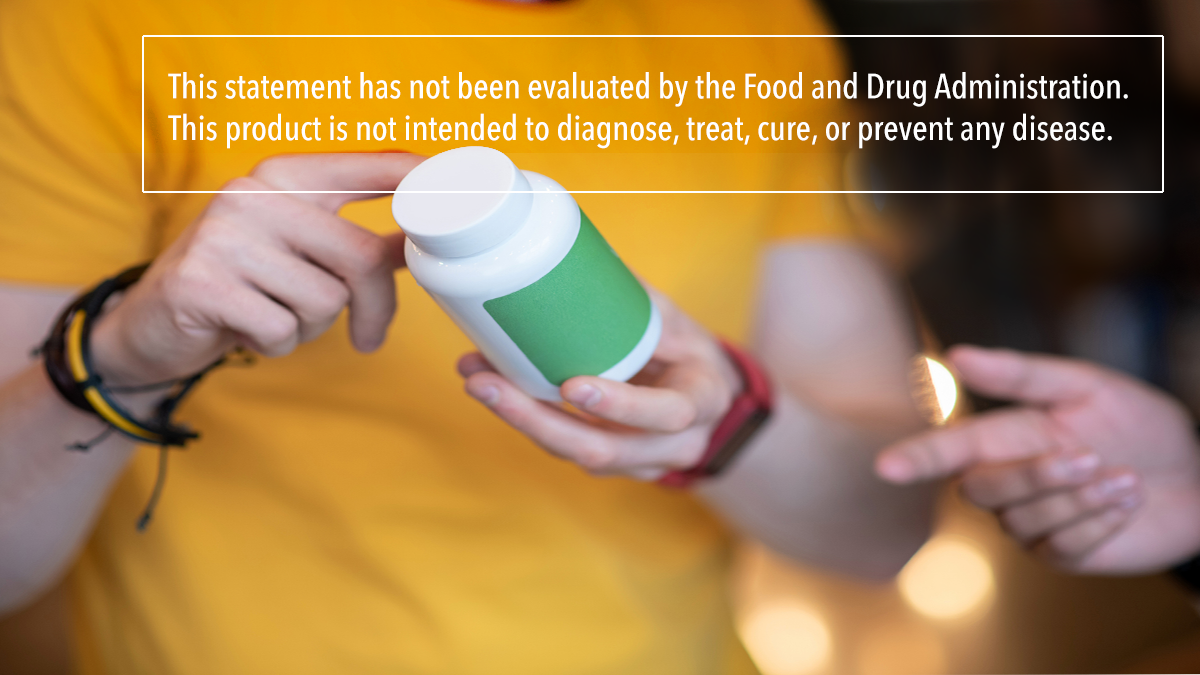
FDA has promised but delayed formal rulemaking on DSHEA disclaimer placement, while class action litigation continues to move forward.
Why it matters:
Companies are operating in a regulatory gray zone where compliance does not eliminate legal exposure—creating reputational and financial risk even for responsible actors.
CRN in action:
CRN is pressing FDA through a Citizen Petition calling for the agency to formalize its position through a Direct Rulemaking and confirm that the interpretation applies retroactively and preempts conflicting private legal actions.
EXECUTIVE INSIGHT:
Until FDA provides clarity, labeling decisions remain a legal risk—not just a regulatory one—even for companies operating in good faith.
CRN Speaks
FROM SUPPLYSIDE CONNECT
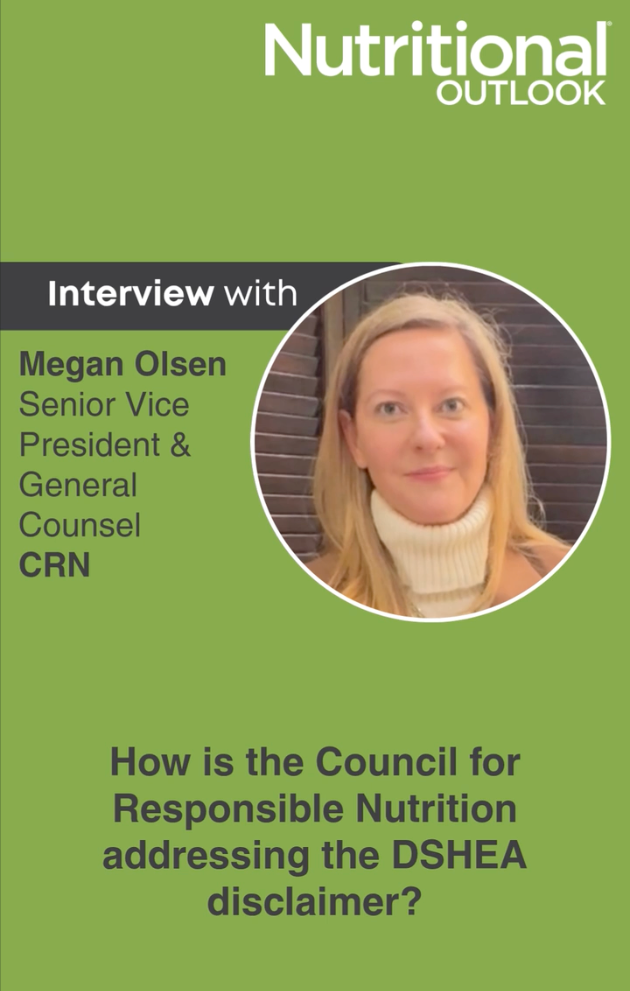
The DSHEA disclaimer on supplement labeling is "something that we've advocated for a while...we think the time is right. We have the agency's attention, and they seem very willing to want to provide a solution for this issue," CRN SVP and General Counsel Megan Olsen said in a Nutritional Outlook interview on site at SupplySide Connect, where she spoke on the "Regulatory Reality Check" panel.
CRN is currently in conversations with FDA on a path forward, Olsen explained, ideally with the agency issuing rulemaking in a procedural way that will give companies some relief.
Olsen also discussed other policy priorities for CRN with Nutritional Outlook, noting the drug preclusion issue and increasing consumer access to dietary supplements through FSA and HSA accounts. "...that's already done for certain supplements, like prenatals, for example, but we believe it should extend to other products such as multivitamins..."
3. Age Restriction Laws Could Spread State-by-State
What’s happening:
CRN is petitioning the U.S. Supreme Court to review New York’s supplement age restriction law, as similar legislation emerges in multiple states.
Why it matters:
If New York's law is left in place, it could trigger a patchwork of state-level access restrictions, not only on age, but even self-service access, directly impacting sales channels, delivery options, labeling, marketing, and brand positioning.
CRN in action:
CRN's legal challenge to prevent a fragmented, state-by-state regulatory environment is the industry's only legal effort to challenge the law. Learn more...
EXECUTIVE INSIGHT:
If state-level age restriction laws take hold, companies may face a fragmented market where product access—and revenue potential—varies significantly by geography.
4. California Policy Signals a New Wave of Consumer-Facing Regulation
What’s happening:
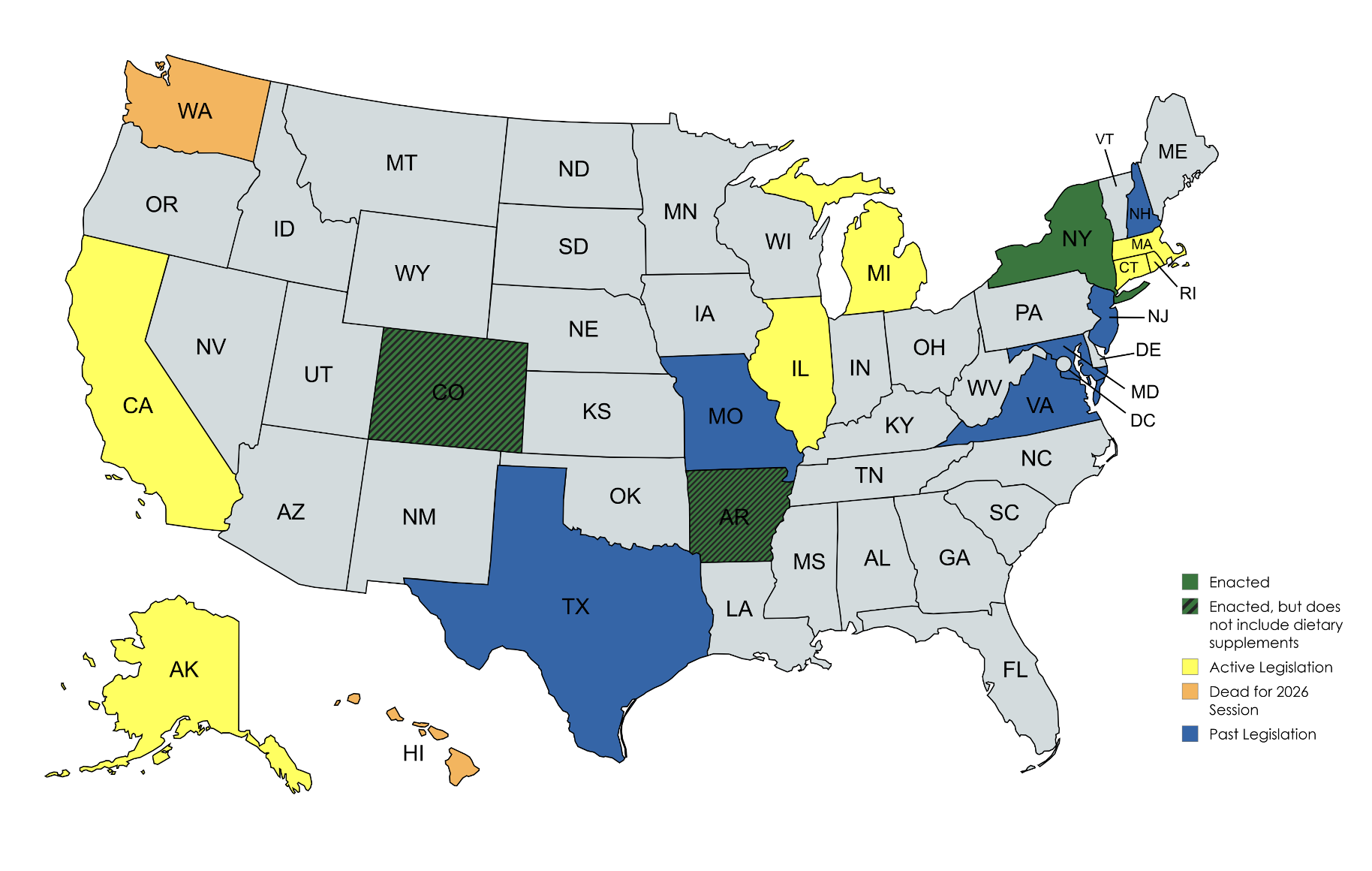
California is advancing legislation demanding heavy metal testing disclosure for protein products and enforcing new date labeling requirements with unclear applicability to supplements.
- California AB 660 standardizes shelf-life date labeling for “food items for human consumption,” effective July 1, 2026, and requires the use of specified terms such as “BEST if Used by” and “USE by” while prohibiting other date-labeling terminology.
- California SB1033 would impose new state-specific testing, disclosure, and labeling mandates related to detectable heavy metals in protein powder and other concentrated protein products sold in California.
Why it matters:
These policies risk creating consumer confusion and de facto national standards, given California’s market influence—potentially forcing costly testing disclosure, relabeling, reputational risk management, and consumer confusion.
CRN in action:
CRN is pushing to amend legislation, clarify applicability, and prevent misleading consumer communication, strengthening in-state advocacy.
EXECUTIVE INSIGHT:
California policy often becomes de facto national policy—meaning state-level actions can quickly translate into nationwide operational and reputational implications.
5. Tariff Volatility Adds Cost Uncertainty to Global Supply Chains
What’s happening:
Recent legal developments affecting tariff authority—and evolving trade agreements—are creating continued uncertainty in import/export costs.
Why it matters:
Tariff instability affects ingredient sourcing costs, pricing strategy, and margin predictability.
CRN in action:
CRN provides its members with direct access to trade counsel and real-time guidance to navigate shifting tariff exposure. CRN presented members-only as well as industry-wide webinars on tariff updates and refunds. Most recently, CRN met with the Department of Commerce to advocate for the exclusion of dietary supplement and food ingredients from any tariff actions under the Section 232 pharmaceutical investigation.
EXECUTIVE INSIGHT:
Ongoing tariff uncertainty is making cost structures less predictable—requiring more proactive supply chain and pricing strategies to protect margins.
CRN Member Executive Spotlight
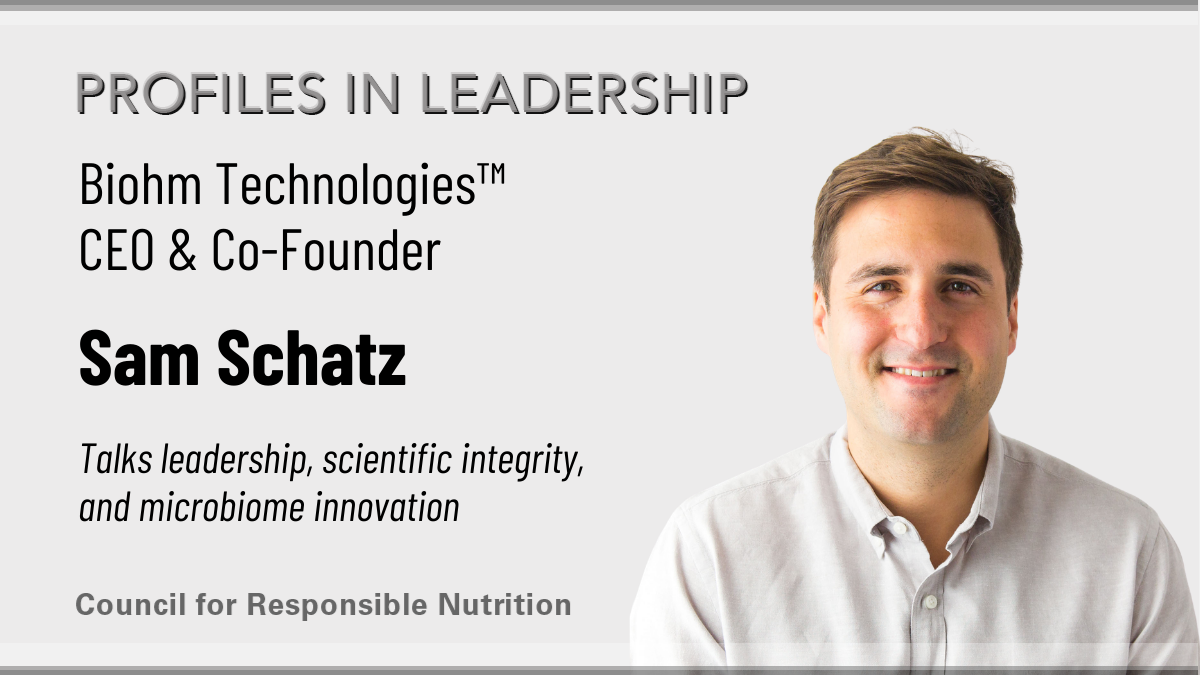
Sam Schatz has built his career at the intersection of data science and biology, driven by a long-standing curiosity about how technology can unlock a deeper understanding of human health.
As CEO and Co-Founder of Biohm Technologies, Schatz leads the company’s research-driven approach to microbiome innovation, combining bioinformatics, clinical research, and large-scale biological data to advance next-generation gut health solutions. His leadership philosophy emphasizes intellectual honesty, collaboration, and empowering experts—an approach shaped during his time helping scale ag-tech company AeroFarms from its earliest stages.
Today, Schatz is guiding Biohm’s evolution toward a B2B ingredient strategy while expanding research into both bacterial and fungal microbiome ecosystems, an area he believes holds significant promise for the future of targeted probiotic innovation. Learn more about Schatz’s leadership philosophy and Biohm’s scientific approach in our “Profiles in Leadership” series.
Learn how your company can benefit from being part of the CRN member community.
Questions? Please contact CRN Senior Director of Membership Ed Wyszumiala (ewyszumiala@crnusa.org / 989-598-5275).