

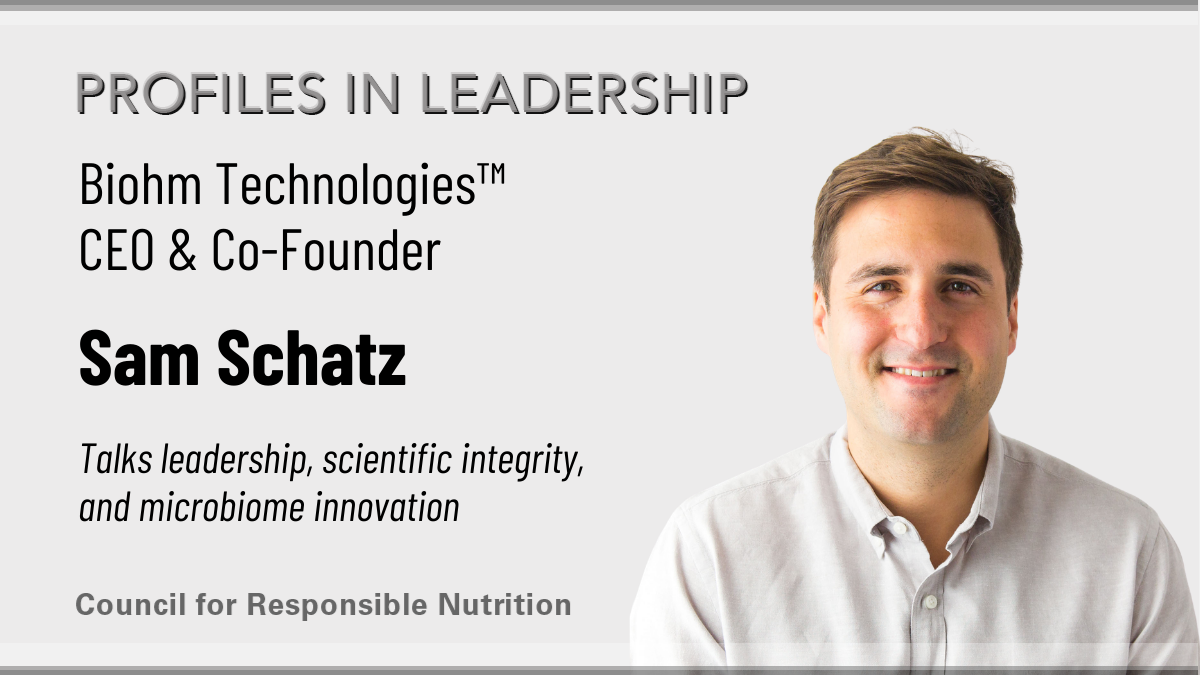
Long before leading Biohm Technologies, Sam Schatz was drawn to one central question: when would technology finally allow us to truly understand biology at scale? Today, as CEO and Co-Founder of Biohm, that question sits at the heart of his leadership approach and the company’s scientific direction. “I’ve always been fascinated by the intersection of data science and biology,” Schatz said. “For years, the limiting factor was computing power. Now we’re at a point where discovery can happen faster and more intelligently than ever before.”
That systems-based thinking was shaped during his time at AeroFarms, where he helped scale a vertically integrated agriculture technology company from its earliest stages. As the first employee after the founders, Schatz wore many hats, from recruitment to culture building to operational strategy, helping the company grow to hundreds of employees.
That experience fundamentally shaped his leadership philosophy. “You have to be intellectually honest about what you don’t know,” he explained. “Then you surround yourself with experts and empower them. I’m not a molecular biologist. If I hit a wall, the answer is not to force it. It’s to hire someone who can go deeper than I can.”
That mindset has been central to Biohm’s evolution. Originally positioned as a consumer-facing brand, the company has shifted toward a B2B ingredient strategy under Schatz’s leadership, leaning into its strength in microbiome testing, bioinformatics, and clinically validated research.
At the core of Biohm’s differentiation is its dual focus on both bacterial and fungal microbiome data. While most probiotic innovation has centered on bacteria, Schatz believed the future of gut health required a broader lens. “For nearly a decade, we’ve been studying not just bacteria but fungi in the microbiome. We consistently see certain fungal organisms present in healthy cohorts that are absent in unhealthy ones,” he said. “Yet very few probiotic fungi exist in the market today. That’s a real opportunity.”
Biohm is investing accordingly. The company has expanded its post-production scientific capabilities, including launching a laboratory in Atlanta to continue research and optimization after ingredient commercialization. “There’s the science before an ingredient enters the market, and then there’s the science after,” he said. “Supporting partners, optimizing formulations, generating additional data. That ongoing work is just as important.”
Access to large-scale real-world microbiome datasets has also accelerated Biohm’s innovation cycle. By combining biological insight with bioinformatics modeling, the company can test hypotheses digitally before advancing to clinical trials, improving study design and precision. “Biology should lead, and bioinformatics should support it,” Schatz said. “When those teams work in constant communication, you shorten the innovation cycle without sacrificing rigor.”
At the same time, Schatz recognized that science alone does not drive consumer adoption. One of the greatest challenges in the microbiome space is translating structure function claims into messaging that resonates without oversimplifying. “The foundation is the science,” he said. “But brands also need emotional connection. If it’s only science, it can feel inaccessible. If its only emotion, consumers become skeptical. The strongest brands thread that needle.”
He also saw ongoing opportunities for education in the category, particularly around persistent probiotic myths. “As consumers become more informed about how these products actually work, the entire category benefits,” Schatz said. “Education raises the bar for everyone.”
That belief in collective advancement extended to industry collaboration. Schatz viewed trade associations as essential to strengthening policy engagement, fostering communication, and reinforcing consumer trust. “When the industry works together, trust grows. And trust is foundational. Without it, everything becomes more difficult,” he said.
Looking ahead, Schatz hoped Biohm’s work would help expand how the industry defines microbiome innovation. By elevating the role of fungi and inter-kingdom relationships within the gut, he believed the next generation of products could become more targeted and more effective. “The future of gut health is about understanding the full ecosystem,” he said. “When you step back and look at the system as a whole, you unlock entirely new possibilities.”
For those considering entering the microbiome or supplement space, Schatz offered encouragement. Despite its complexity, he described the industry as collaborative and welcoming. “It can seem intimidating at first,” he said. “But there are incredible people here who are generous with their time and knowledge. If you’re curious and willing to learn, there’s real opportunity.”
With a leadership style rooted in curiosity, scientific integrity, and long-term thinking, Schatz is positioning Biohm at the forefront of microbiome innovation—not by chasing trends, but by building durable science that supports the entire ecosystem.