

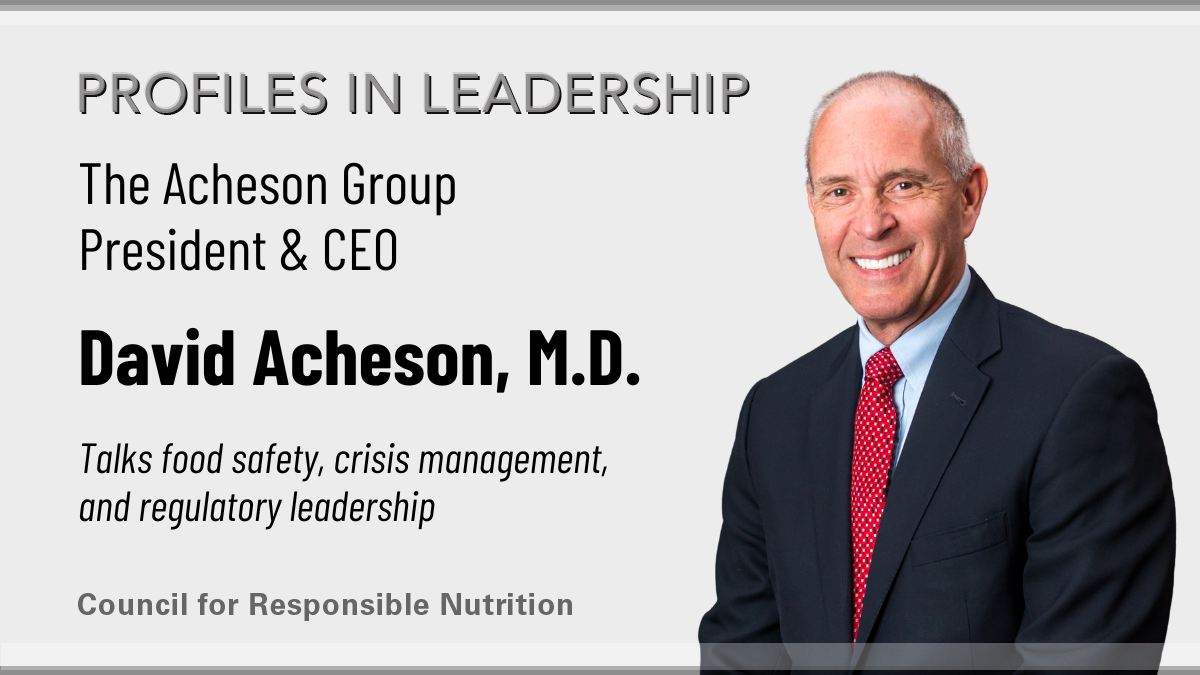
Few leaders in food safety have seen the industry from as many angles as David Acheson, M.D., who has spent his career moving across medicine, science, government, and consulting.
Over the course of his career, Dr. Acheson practiced medicine, led scientific research, served in senior leadership roles at both FDA and USDA, and built a global consulting firm that helps companies navigate some of the industry's most complex challenges. Each chapter built upon the last, giving him a perspective that extends beyond regulatory compliance to encompass public health, business strategy, and crisis management.
His journey began in the United Kingdom as an internal medicine physician specializing in infectious diseases, where treating patients with foodborne illnesses first sparked his interest in food safety. A research fellowship at Tufts University brought him to the United States, where his work on E. coli coincided with the 1993 Jack in the Box outbreak, a defining moment that transformed public awareness of food safety and ultimately led Dr. Acheson into government service.
After serving as chief medical officer at USDA's Food Safety and Inspection Service and later holding several leadership positions at FDA, including Associate Commissioner for Foods, Dr. Acheson transitioned into consulting. In 2013, he founded The Acheson Group (TAG), which has since grown into an international consulting firm supporting companies worldwide.
What makes Dr. Acheson's perspective unique, he says, is the combination of experiences that shape how he approaches risk.
"There are not many physicians who spent 10 years doing clinical medicine who wind up doing what I do," he said. "Then have the regulatory experience, the basic science experience and now the industry experience."
Rather than viewing food safety through a single lens, Dr. Acheson focuses on balancing public health, regulatory expectations and business realities. He encourages organizations to think beyond technical compliance and evaluate the broader strategic risks they face, including protecting consumer trust.
"When you're talking to CEOs and boards of directors about where do we need to put our money and true concern, it's the combination of, 'Am I going to kill anybody? Am I going to have FDA crawling all over me? Is my reputation going to tank?'"
That holistic approach has become increasingly important as the industry evolves.
As his career has unfolded, Dr. Acheson has watched consumer expectations shift dramatically. Foodborne pathogens remain a critical focus, but public conversations now extend to heavy metals, pesticides, food additives and ultra-processed foods. At the same time, social media has fundamentally changed how companies respond to emerging issues.
"If you screw up, your reputational vulnerability is much more fragile than it ever used to be," he said. "Consumers will throw a brand under the bus, not always for the right reasons, but it happens."
For companies trying to navigate today's rapidly changing environment, Dr. Acheson believes one lesson stands above the rest: stay current.
Regulations evolve, consumer perceptions change, new technologies emerge, and artificial intelligence is beginning to reshape how companies identify and manage risk. Organizations that continuously monitor those changes are better positioned to respond before challenges become crises.
"I've given talks around managing the changing landscape of food safety for 20 years," he said. "If I look at my deck today versus the deck when I first started, it's completely different. The concept hasn't changed. The content does."
Leadership, he says, requires both technical expertise and the ability to communicate across every level of an organization. Food safety professionals must understand the details while also translating risk into business terms that executives and boards can act upon.
"You've got to understand the 500,000-foot picture and the five-inch picture," Dr. Acheson said. "You've got to communicate and manage upwards effectively and communicate and manage downwards effectively."
For professionals entering the field, his advice is straightforward: gain broad experience, stay curious and never lose sight of the bigger picture. "Keep your eyes open," he said. "Don't just be focused on the narrow. Try to stay apprised of what's going on at a higher level too."
After decades in food safety, Dr. Acheson remains energized by one thing above all else: helping companies solve difficult problems when the stakes are highest. "It's constantly changing," he said. "One of the things I love the most is helping pull people out of a pickle."
Whether guiding organizations through a product recall, navigating regulatory uncertainty, or helping prevent the next crisis, Dr. Acheson sees the work as serving both businesses and the public—and as a responsibility he values deeply.
"You're protecting the public. You're doing good stuff," he said. "At the same time, you're helping protect businesses, and you're working with people who genuinely want to do the right thing."